

Deep Draw Metal Stamping: Definition, Basics, and
Introduction
Deep draw metal stamping, also widely called deep drawn stamping, is a specialized cold sheet metal forming branch under metal stamping. It turns a flat metal blank into seamless hollow 3D shells, cups, enclosures and sleeves by controlled material flow, rather than simple cutting or bending. For engineers, procurement buyers and OEM manufacturers, it is one of the most reliable high-volume methods to produce deep hollow components with consistent wall thickness and one-piece construction.
Many buyers confuse deep drawing with regular metal stamping. Standard stamping focuses on blanking, piercing and shallow bending; deep draw stamping lets metal flow radially into the die cavity, for parts where depth is equal to or greater than the opening diameter. This guide breaks down its definition, working basics, common materials, core benefits, typical applications and its strategic importance in modern manufacturing.
What Is Deep Draw Metal Stamping?
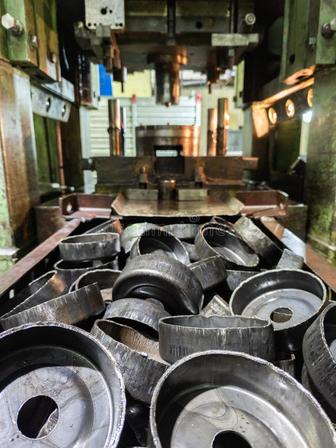
Deep draw metal stamping is a cold forming process that uses a punch, die and blank holder to pull a flat sheet metal blank into a die cavity, forming a seamless hollow part through plastic deformation.
Industry convention labels a component as deep drawn when its cavity depth reaches or exceeds its diameter. If the depth is smaller, it is classified as shallow drawing. The blank holder (hold-down ring) is critical: it applies uniform pressure to stop the outer edge of the blank from wrinkling while the punch draws material inward.
Unlike welded, machined or fabricated hollow parts, deep drawn parts are single-piece, no seams or joints. Material deforms under combined radial tension and circumferential compression, not pure stretching, to maintain stable wall thickness where possible.
Basics of the Deep Drawing Process
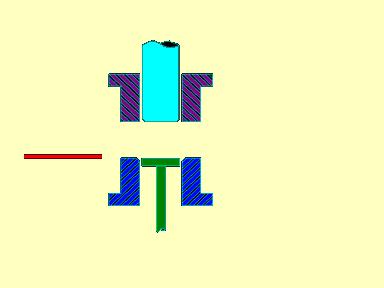
The deep draw workflow follows clear, repeatable steps. For deeper geometries, multiple draw operations (redrawing) are used instead of one single stroke to avoid tearing or excessive thinning.
- Blank PreparationA flat blank is cut from sheet coil or sheet stock, calculated by blank diameter formula based on final part surface area. Blank size directly affects material utilization and forming stability.
- Blank HoldingThe blank sits on the die surface, clamped by a blank holder with controlled force. Too little force causes wrinkling; too much force creates excessive tension and part cracking.
- First Draw FormingThe punch descends, pulling the center of the blank down into the die cavity. Metal flows gradually from the flange into the cavity. Lubrication reduces friction between blank, punch and die to protect surface quality and control thinning.
- Redrawing (for deep parts)If the target depth cannot be achieved in one pass, the pre-formed cup moves to the next die set for redrawing, reducing diameter and increasing depth step by step.
- Trimming & Secondary OperationsAfter drawing, excess flange material is trimmed. Common secondary processes include piercing, flanging, tapping, surface finishing and plating.
- Part Ejection & InspectionFinished parts are ejected, then checked for dimensions, wall thickness, cracks, wrinkles and surface defects.
Key Process Variables
- Blank holder force
- Punch & die clearance
- Material ductility and grain direction
- Lubricant selection
- Draw ratio (the most critical design limit: maximum reduction per draw)
- Draw radius on punch and die corners
Common Materials for Deep Draw Stamping
Not all sheet metals suit deep drawing. Ductility is the top requirement, as the material must flow without fracture.
- Cold rolled steel (CRS): Low carbon steel is the most popular, excellent drawability, low cost for general enclosures and housings.
- Stainless steel: 304, 316 stainless for corrosion-resistant parts such as medical housings, sensor sleeves and fluid containers. Stainless steel needs careful process tuning due to higher work hardening.
- Aluminum alloys: 5052, 5251 and similar soft grades for lightweight electrical, automotive and consumer hardware parts.
- Copper & brass: High ductility, used for conductive shells, battery contacts and electromagnetic shielding components.
Materials with poor ductility are generally not recommended for deep drawing, as they easily crack during material flow.
Core Importance & Key Advantages of Deep Draw Metal Stamping
Deep drawing remains irreplaceable in high-volume manufacturing because it solves pain points that welding, casting or CNC machining cannot match economically.
1. Seamless, Leakproof One-Piece Structure
No weld seams mean no weak welding points. Deep drawn shells are ideal for pressure-bearing, liquid-tight or gas-tight parts. Welded joints are common failure sources under pressure, vibration or corrosion exposure; deep drawing eliminates this risk entirely.
2. Consistent Wall Thickness & High Dimensional Repeatability
With proper tooling, deep drawn parts maintain stable wall thickness across mass runs. Once the die is validated, thousands or millions of parts share tight tolerances, perfect for automated assembly lines.
3. Improved Strength from Work Hardening
Cold plastic deformation creates work hardening along the material grain flow. Deep drawn components often gain higher tensile strength than the original raw sheet, delivering a favorable strength-to-weight ratio.
4. Lower Unit Cost for High-Volume Production
Tooling has upfront investment, but per-part cost drops sharply at large batch sizes. Compared to CNC machining from solid bar stock, deep drawing cuts cycle time dramatically and reduces material waste.
5. Minimal Scrap & Better Material Efficiency
The blank is cut to near-net shape, and most of the sheet flows into the final part. Scrap rates are far lower than subtractive machining processes, supporting cost control and sustainability targets.
6. Superior Surface Quality
When lubricated and tooled correctly, deep drawn parts have smooth inner and outer surfaces. They avoid weld marks, grinding marks or porosity typical of cast and welded alternatives, simplifying post-processing like painting, powder coating or plating.
Top Industrial Applications of Deep Drawn Stamped Parts
Deep draw components are everywhere in industrial supply chains:
- Automotive: Sensor housings, battery cans, fuel system sleeves, hydraulic component shells, motor cans
- Medical devices: Implant covers, diagnostic instrument housings, sterile fluid containers
- Electronics & battery: Lithium battery cases, shielding cans, connector shells, power supply enclosures
- Aerospace & defense: Lightweight protective covers, pressure vessels and precision housings
- Appliance & consumer hardware: Compressor shells, pump housings, aerosol cans and cooking containers
- Industrial equipment: Hydraulic and pneumatic cylinder sleeves, filter housings, bearing cups
Deep Draw Metal Stamping vs Conventional Metal Stamping
Many buyers ask the difference, and this comparison clarifies process selection:
- Conventional stamping: Focused on blanking, piercing, bending, embossing; mainly shearing and shallow forming; simple 2D or shallow 3D geometry.
- Deep draw stamping: Specialized subset of metal stamping; relies on controlled plastic flow; for deep hollow shells, cups and enclosures; governed by draw ratio, wrinkling and thinning control.
Shallow bending cannot replace deep drawing when you need a tall, closed-bottom hollow shell with uniform walls.
Common Defects & Design Considerations
Deep drawing is sensitive to design choices. The most frequent defects include:
- Wrinkling: insufficient blank holder force
- Splitting / tearing: excessive draw ratio, sharp corner radii, too high blank holder pressure
- Uneven wall thinning: poor lubrication or mismatched die clearance
- Earing: anisotropy from sheet metal grain direction
For design for manufacturability (DFM):
- Use generous punch and die radii
- Avoid abrupt shape transitions
- Follow safe draw ratio limits
- Align grain direction properly
- Confirm material ductility before tooling release
Frequently Asked Questions
Q1: Is deep drawing the same as metal stamping?
Deep draw stamping is a specialized category of metal stamping. All deep drawing is stamping, but not all stamping is deep drawing.
Q2: Can deep drawing produce rectangular or irregular shapes?
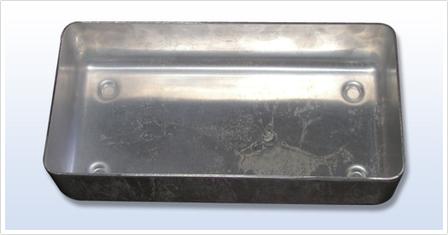
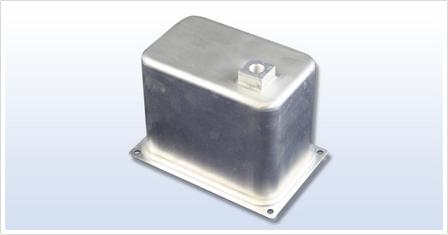
Yes. While cylindrical parts are easiest, square, rectangular and contoured hollow shells are achievable, usually requiring multiple redraw steps and custom blank outlines.
Q3: Is deep drawing suitable for low-volume orders?
Deep drawing has higher die costs. It is most cost-effective for medium to high volume. For small batches, hydroforming or CNC machining may be better alternatives.
Conclusion
Deep draw metal stamping is a foundational sheet metal forming technology built on controlled plastic material flow. Its core value lies in producing seamless, dimensionally stable, high-strength hollow components at competitive unit pricing for mass production.
For OEM engineers and sourcing teams, understanding deep drawing basics helps you select the right manufacturing route, avoid costly design mistakes, and specify reliable housings, cans and sleeves for automotive, medical, electronics and industrial equipment. When your design requires a deep hollow, leak-resistant one-piece metal shell, deep drawn stamping is often the optimal solution.