
Sourcing custom deep drawn metal parts involves navigating material science, tooling investment, tolerance requirements, and the critical OEM vs. ODM decision. This guide breaks down what global buyers need to know before sending an RFQ—and how to evaluate whether a manufacturer's capabilities align with your project requirements.
What Makes Deep Drawing Different from Standard Metal Stamping
Deep drawing transforms a flat metal blank into a seamless, hollow component—typically with a depth greater than its diameter—through a single press stroke or multi-stage sequence. Unlike conventional stamping, which handles cutting, piercing, and shallow bending, deep drawing forces the material to flow radially into a die cavity, producing cylindrical, box-shaped, or complex geometric parts without welding or joining.
This distinction matters for your part design. Deep drawn components eliminate structural weak points found in welded assemblies and deliver consistent wall thickness with dimensional repeatability. Limiting draw ratios typically range from 1.8 to 2.3 for a single draw, with multi-stage sequences extending capbility above 3.0 for more demanding geometries.
Common applications span automotive sensor housings, appliance components, electronics enclosures, medical device shells, and industrial containers—any scenario where a seamless, high-volume metal housing is required.

Material Selection: Matching Alloy to Your Part Requirements
Material choice directly impacts drawability, tool life, and final part performance. Key considerations:
Carbon Steel offers the widest forming window with draw ratios of 2.15–2.5, making it suitable for high-volume applications where cost efficiency matters. Low-carbon grades perform best under cold forming conditions.
Stainless Steel delivers corrosion resistance and surface quality critical for medical, food processing, and chemical applications. However, stainless requires higher press force—typically 1–2 times that of carbon steel—and often needs annealing between draw stages to prevent work hardening from causing fractures.
Aluminum Alloys provide lightweight alternatives for automotive and electronics applications, with good formability in grades such as 1100 and 3003. Copper and brass alloys serve electrical conductivity requirements.
A capable manufacturer maintains in-house expertise across these material families—and can recommend the optimal grade based on your functional requirements, not just what's easiest to process.
Tolerances and Quality Control: What "Precision" Actually Means
Precision deep drawing tolerances vary by dimension and manufacturer capability. Industry benchmarks include:
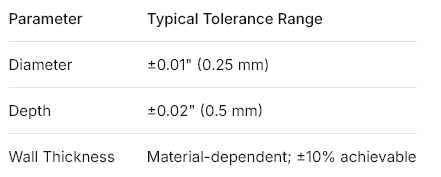
These tolerances are achievable under controlled production conditions—but only when the manufacturer operates calibrated equipment, maintains documented die maintenance schedules, and performs in-process inspection. Ask potential suppliers for die maintenance logs and first article inspection (FAI) reports as standard practice.
For regulated industries, ISO 9001 certification represents the baseline quality management standard. Automotive programs typically require IATF 16949, while aerospace applications may demand NADCAP accreditation or equivalent process controls.
OEM vs. ODM: Choosing the Right Engagement Model
Understanding the distinction between OEM and ODM prevents costly misalignment on design ownership, liability, and lead time:
OEM (Original Equipment Manufacturing): You provide engineering drawings (PDF, DWG, STEP, or IGES), material specifications, tolerances, and inspection requirements. The manufacturer executes your design with precision—no design changes without your approval. This model suits proprietary components, replacement parts, and existing product lines.
ODM (Original Design Manufacturing): The manufacturer owns the design and produces catalog or semi-custom parts to your performance requirements. You select from existing tooling or adapt standard components, typically achieving faster lead times and lower tooling investment. This model works well for new product development where speed-to-market outweighs full design control.
For custom deep drawn components, OEM is the more common engagement. But some manufacturers offer hybrid approaches—using existing tooling as a starting point for ODM-based customization, then transitioning to OEM production as volumes scale.
Full-Service Capabilities: From Drawing to Delivered Part
A complete deep drawing partner typically integrates multiple processes under one roof:
Tooling Design and Development — Progressive die design, draw simulation to predict material flow and springback, and tooling fabrication. FEA-based draw simulation before tooling approval reduces trial-and-error costs significantly.
Deep Drawing Production — Mechanical or hydraulic presses with blank holder force control to prevent wrinkling. Production rates of 15–40 parts per minute on mechanical presses support large-scale programs.
Secondary Operations — Trimming, piercing, flanging, threading, and surface finishing (plating, anodizing, powder coating) as needed.
Quality Verification — Dimensional inspection, material certification, and documentation packages that align with your industry's compliance requirements.
When evaluating a manufacturer, ask for recent workshop photos showing the actual equipment, deburring stations, and inspection equipment that would be used for your order. Trading agents may claim broad capabilities; verifiable in-house equipment is the stronger signal.
What to Include in Your RFQ: A Practical Checklist
Submitting a complete technical package accelerates quoting and reduces back-and-forth. A quote-ready RFQ for deep drawn parts should include:
2D engineering drawing with GD&T callouts for all critical dimensions
3D model (STEP format preferred over mesh STL files)
Material grade and thickness (e.g., SPCC 0.7 mm, SUS304 0.5 mm)
Surface finish requirements (plating type, coating thickness, cosmetic acceptance criteria)
Annual quantity and order frequency to inform tooling amortization
Critical-to-function dimensions that interface with mating components
Required documentation (material certs, PPAP level, FAI reports, RoHS/REACH compliance)
Incomplete RFQs—particularly those missing material grade or critical tolerances—are the leading cause of quote delays and inaccurate pricing.
Industry-Specific Considerations
Different sectors impose distinct requirements on deep drawn components:
Automotive — IATF 16949 quality systems, PPAP documentation, and consistent high-volume output. Sensor housings, fuel system components, and structural enclosures must meet dimensional stability across millions of units.
Medical Devices — biocompatible materials, cleanroom-compatible manufacturing, and full traceability from raw material lot to finished part.
Electronics — tight tolerance control for EMI shielding effectiveness, with consistent wall thickness ensuring predictable attenuation performance.
Industrial Equipment — cost-optimized solutions for filters, containers, and protective housings where functional performance matters more than cosmetic perfection.
A manufacturer serving multiple industries brings cross-sector learning—tooling strategies from automotive transfers to medical applications, and quality systems from regulated sectors elevate standards across all programs.
Why Global Buyers Partner with Hony Tai
Hony Tai specializes in customized processing of metal structural components, delivering full-range fabrication solutions across deep drawing, metal stamping, sheet metal fabrication, and precision machining.
What we bring to your program:
Multi-process integration — Deep drawing, stamping, and machining under one roof eliminates coordination overhead and ensures process consistency
Drawing-to-production capability — From tooling design through finished parts, with engineering support on material selection and design-for-manufacturability
Non-standard part expertise — Standard and custom hardware components developed from customer drawings and samples
Quality-focused production — Strict precision control and production quality management at every stage
Stable delivery — Reliable lead times backed by mature manufacturing technology and production planning
Cost-effective solutions — Competitive pricing without compromising on dimensional accuracy or material integrity
We serve diverse industries with reliable products and welcome global clients seeking long-term, stable cooperative partnerships.