

Most deep drawn component projects do not fail at the press. They fail earlier — at the RFQ stage, when a supplier quotes a part without flagging the draw ratio, the wall-thickness gradient, or the tooling strategy that will decide whether the design survives the transition from prototype to production. For OEM sourcing teams and design engineers, the real question is not “can this shop draw metal,” but “can this shop draw your part repeatably, at volume, with documentation that holds up.”
Here is a practical framework for vetting a custom deep drawn components manufacturer — the same criteria that separate a transactional prototype vendor from a production partner.
1. DFM Is Not a Formality — It Is the Cost Decision
A supplier that accepts your drawing without a manufacturability review is not saving you time. It is deferring cost to the tooling phase. Deep drawing is a controlled balance of material flow, friction, strain, and tooling performance; every one of those variables can move piece price up or down before a die is ever cut.
Ask for a DFM report that covers:
Draw ratio and redraw strategy. When depth exceeds diameter, forcing a single draw increases thinning and tearing risk. A competent partner will calculate whether one draw, multiple redraws, or an intermediate anneal is required — and explain the tooling implications.
Wall-thickness gradient. A drawn wall is not uniformly thick. It is near nominal at the bottom centre, thinnest in the lower wall, and slightly thicker at the top edge. A wall-thickness callout without a measurement position is unenforceable; the supplier and the buyer can measure at different heights and both be “correct.”
Die entry radii and fracture risk. Tight radii in CAD translate to higher forming stress and more rejects. A supplier that flags this early is protecting your launch, not padding the quote.
Material grade and temper specificity. “Stainless” is not a specification. 304, 316L, and 430 route differently through the same shop, with different tooling and pricing consequences.
Hony Tai’s engineering team runs DFM reviews on customer drawings and samples before quoting — not after tooling is committed. That is the difference between a quotation and a production plan.
2. In-House Process Breadth Signals Control — and Fewer Handoffs
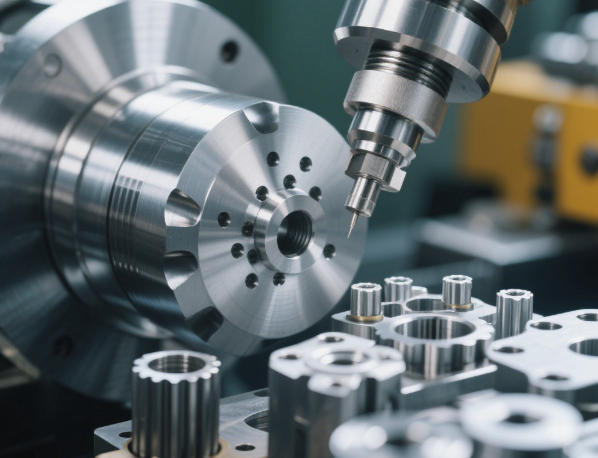
A deep drawn part is rarely finished at the draw press. Trimming, piercing, flanging, annealing, surface treatment, and secondary machining all affect final tolerance and lead time. Suppliers that keep deep drawing, metal stamping, sheet metal fabrication, and precision machining under one roof eliminate the coordination loss that comes from subcontracted operations.
When evaluating a manufacturer, ask a direct question: which operations happen inside your facility, and which are outsourced? A supplier with integrated capabilities has tighter control over dimensional drift between operations, shorter recovery time when a first article needs adjustment, and clearer accountability when something goes out of tolerance.
3. The RFQ Is a Technical Document — Treat It Like One
Incomplete RFQs are the single largest source of quotation delay in deep drawn stamping. A quote that arrives without a clarification loop is only possible when the buyer provides: the controlled drawing and 3D model at the same revision; material grade, temper, and thickness; annual volume and first-batch quantity; critical tolerances with datum scheme; surface finish and masking areas; and required documentation (PPAP, IMDS, material certificates).
On the supplier side, a manufacturer worth shortlisting should be able to answer three questions about every quotation:
What draw ratio, blank size, and press tonnage did you calculate?
Which dimensions are set by the tooling, and which will drift with material lot and springback?
What is the lead-time split between building the tool and producing saleable samples?
If the answers are vague, the quote is a placeholder, not a commitment.
4. Prototype-to-Production Is a Process, Not a Handoff
A prototype made by CNC machining or a temporary tool proves geometry; it does not prove production readiness. The production process introduces tooling effects, material-lot variation, and inspection requirements that a prototype never exercised.
A credible deep drawn manufacturer manages the transition through four checkpoints:
DFM update after prototype review. Prototype findings should feed back into the drawing — radii, wall thickness, feature placement — before production tooling is cut.
Material and secondary-operation freeze. Production material grade, heat treatment, plating, and passivation are locked before pilot run, not discovered during ramp.
Pilot run with first-article data. The first parts off production tooling are measured against the control plan, not just visually inspected.
Production quality plan transfer. Key characteristics, sampling frequency, gauges, and traceability requirements are documented and agreed before full release.
Hony Tai supports customers through this sequence with in-house stamping, deep drawing, sheet metal fabrication, and precision machining — so the process knowledge from prototype stays with the same team that runs production.
5. Trust Signals That Matter to OEM Buyers (Beyond the Certificate Wall)
Certifications open doors, but they do not close programs. In B2B industrial sourcing, trust is built through verifiable execution evidence: clear capability explanations, real-world case details, consistent quality documentation, and transparent organizational accountability.
For a deep drawn components partner, look for:
Tooling ownership clarity. Who owns the die? If you switch suppliers, can you take the tool with you, or will you pay twice?
Reorder behaviour as a proxy for satisfaction. On-time delivery is a baseline; repeat business reflects whether the supplier solves problems across the program lifecycle, not just ships on schedule.
Willingness to discuss failure modes. A manufacturer that can explain tear, wrinkle, and thinning risks — and the process windows that prevent them — is demonstrating production experience, not reciting marketing copy.
Hony Tai works from customer drawings and samples across standard and non-standard hardware components, serving OEM programs that require stable delivery, documented quality, and cost discipline through the full production life cycle.
A Practical Next Step
If you are sourcing a custom deep drawn component and want a quotation that reflects the actual manufacturing route — not a guess — send your drawing, material specification, annual volume, and critical tolerance requirements. A DFM-backed quote will tell you more about a supplier’s capability than any capability brochure.