

Meta description: Deep drawing vs metal stamping is a geometry and volume decision, not a preference. Five engineering questions to settle it before you cut tooling.
Choosing between deep drawing and metal stamping usually comes down to one uncomfortable moment: the design is nearly frozen, the RFQ is out, and someone asks whether the part should really be drawn or stamped. Pick wrong and the cost surfaces later — as wrinkles, tears, tolerance stack-up, or a tool that never amortizes.
Neither process is universally better. The part decides. Here is the same decision sequence our engineers use at Hony Tai when a drawing hits the quoting desk.
1. How deep is the part relative to its diameter?
This filter eliminates most of the ambiguity immediately. Deep drawing pulls a flat blank into a die cavity, so the material flows radially inward and the finished wall is generated from the flange rather than cut and bent into shape. That flow is why deep drawing can produce seamless walls up to roughly 200 mm deep, while conventional stamping is generally limited to shallow forms under about 10 mm.
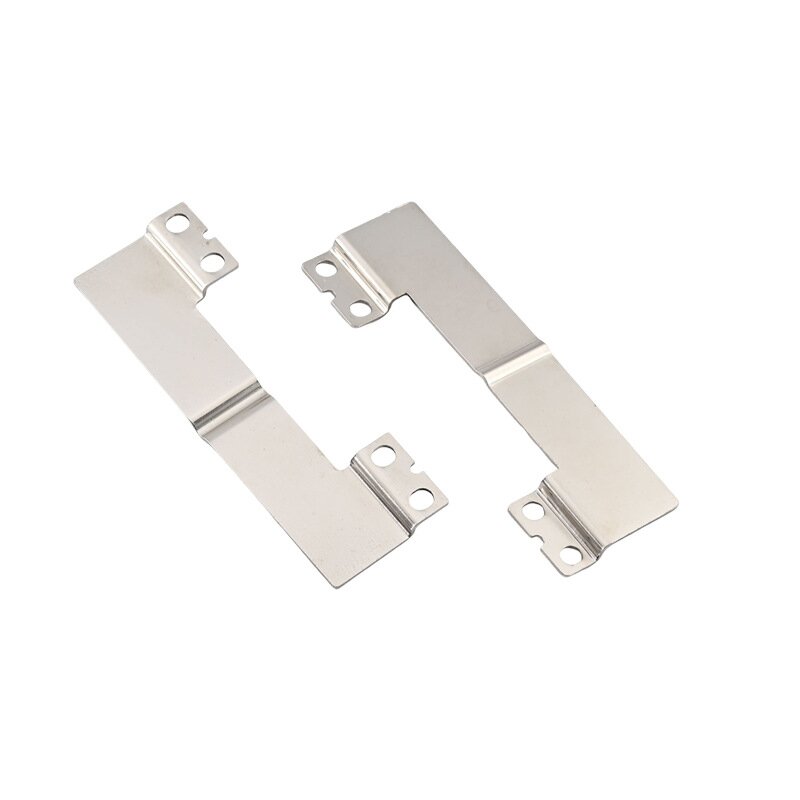
The practical threshold is the depth-to-diameter ratio. Above roughly 0.5, deep drawing takes over; below it, progressive die stamping is usually faster and more economical. If the part is a cup, a can, a closed-end housing, or a sleeve with a continuous wall, start with deep drawing. If it is a bracket, a clip, or a shallow cover with cutouts and bends, start with stamping.
There is also a material-side limit on a single draw. The limiting draw ratio (LDR) — blank diameter divided by punch diameter — typically falls between 1.6 and 2.2 for low-carbon steel and 1.8 to 2.0 for common aluminum alloys. Beyond that, the part needs multi-stage drawing with intermediate annealing, which adds stations and cost.
2. What actually controls the tolerance — flat features or wall integrity?
Progressive die stamping keeps the part registered on a carrier strip through every station. Hole-to-hole position, profile, and flatness can hold very tight — feature-to-feature tolerances down to 0.001 inch (about ±0.025 mm) are routine in high-volume work. If the critical dimensions are hole locations, edge profiles, or flatness on a relatively flat part, stamping holds them more directly.
Deep drawing achieves good overall accuracy but prioritizes wall continuity and concentricity over flat-feature precision. A drawn wall is made from material that has flowed: it thins where it stretches over the punch radius and thickens near the flange. Typical deep drawing tolerances land around ±0.1 mm, with ±0.05 mm achievable on well-controlled diameters. If wall thickness or concentricity is functionally critical, specify it deliberately — it may need ironing or a secondary sizing operation.
Put simply: if flatness and hole position drive the drawing, stamping usually wins; if depth and shell integrity drive it, deep drawing is the right tool.
3. What annual volume justifies the tooling?
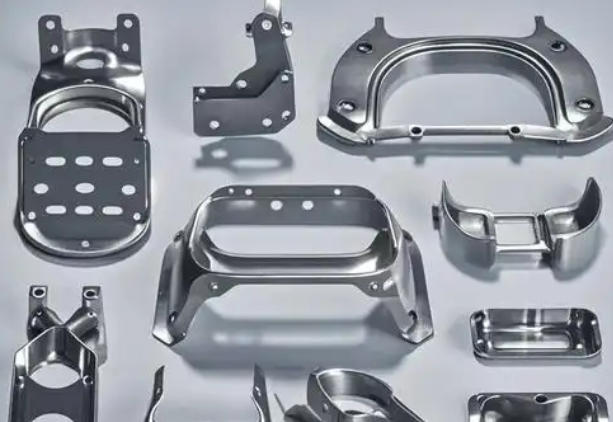
Tooling cost is the largest upfront delta between the two processes, and volume is how you amortize it. A single-operation deep drawing tool is cheaper to build but slower per part; a progressive die costs more upfront and runs faster with no manual handling between stations. The crossover moves with part size, material, and operation count, but the pattern is consistent.
At prototype and pilot quantities, single-operation tooling — or drawing from an existing die library rather than cutting new tool — is the sensible route. At low thousands per year, single-operation or compound tooling is usually enough, and a progressive die is hard to justify on tooling cost alone. At tens of thousands per year and above, progressive or transfer tooling starts to pay back through cycle time and reduced handling.
For deep drawing specifically, tooling cost climbs with high draw ratios requiring multiple redraws, complex geometry, and tight tolerances. Simplifying geometry, using generous radii, and locating critical features after the draw are the most reliable cost levers.
4. Does the material have enough ductility to flow?
Deep drawing is a material-flow process; stamping is largely cutting and bending. That difference sets a hard constraint. Deep drawing demands high elongation, a low yield-strength-to-tensile-strength ratio, and good strain-hardening capacity so the material can flow without tearing. Proven grades include low-carbon drawing-quality steels (AISI 1008–1010), 3003 and 5052 aluminum, copper, brass, and 304 stainless steel. High-strength, low-ductility alloys and heat-treated aluminum grades such as 6061-T6 draw poorly and usually need an annealed temper or a different route.
Stamping tolerates higher-strength materials because deformation is localized rather than global. If the design calls for a high-strength alloy and the geometry is shallow, stamping keeps more material options open.
5. Can a seam be eliminated — and does it need to be?
This is often the deciding question for enclosures and pressure-bearing parts. Deep drawing produces a one-piece, seamless hollow shell with no welded seam, a structural and leak-integrity advantage stamping cannot replicate in a single operation. That is why deep drawing dominates EV battery cell cans, motor housings, sensor shells, medical device enclosures, and fluid-handling components where a seam is a failure path or a corrosion site. If the part is a flat or shallow enclosure and a seam can be welded, riveted, or folded without compromising function, stamping is usually faster and cheaper per part.
The short answer
Deep drawing wins when the part is deep (depth above about 0.5 × diameter), needs a continuous seamless wall, and the critical requirements are wall integrity and concentricity. Progressive die stamping wins when the part is flat or shallow, the critical dimensions are hole position and flatness, and annual volume is high enough to amortize the tool. Near the thresholds, the geometry and the volume together decide — not the process brochure.
Where Hony Tai fits
Hony Tai runs both routes — metal stamping and deep drawing — alongside sheet metal fabrication and precision machining. That matters at the selection stage: we are not pushing one process. We review the drawing, check the depth-to-diameter ratio against the material's LDR, flag which tolerances the process holds naturally and which need a secondary operation, and quote tooling and piece price against the real annual volume.
If your part sits near one of these thresholds — a deep housing that might be drawable in fewer stages, or a shallow enclosure that could be stamped instead of drawn — send us the STEP or PDF drawing. We will tell you which process the geometry actually wants, and what that means for tooling and per-part cost before you commit.